Dave's Faves - Feb 8th, 2021

I was never a huge Grateful Dead fan, but I remember the old Dick’s Picks cassettes that would make their way around the tape-trading circles, originally started by Grateful Dead tape vault archivist Dick Latvala. They were live recordings selected by him and released with permission from the band, based on his favorite performances.

I’m gonna take a queue from Dick and start doing Dave’s Faves, based on my favorite bottles in the store right now. I’ll update this from time to time, as new things come in; it’s 100% based on what I’m drinking at home, not so much what’s new and shiny.

Favorite White Wine Sub-$20: Tendu Clarksburg Cortese $15.95 - 100% Cortese, more often found in the inexpensive and cheerful whites of Piedmont, particularly Gavi! This white originates from the Lost Slough vineyard, located on the Sacramento River Delta - a site that benefits from cool breezes and good diurnal temperature variation, meaning the grapes retain excellent freshness. Fresh and fruity, but with a pleasant, deceptive oomph to the palate - orange peel, soft spice and stone fruits - fuzzy apricots and peaches with a hint of texture. Like all of Steve Matthiasson’s wines, it over-delivers, and is a delightful expression of this Italian grape.

Favorite Red Wine Sub-$20: Tendu Dunnigan Hills Mataro $15.95 - This isn’t just my favorite wine in the store right now, but many of the Mission staff members as well. Super light (lighter than German Pinot Noir), super juicy, fresh, snappy, and just absolutely delicious. Made entirely from organic Mourvedre (Mataro) from Yolo County, where Steve Matthiasson helped grow and source the fruit. The Tendu wines in general are a fun CA project and this one in particular really sings.

Favorite White Wine Sub-$50: 2019 Matthiasson Linda Vista Napa Chardonnay $26.95 - The Linda Vista Vineyard is just across the creek behind Steve’s house. The West Oak Knoll area where he lives is one of the classic Chardonnay spots in Napa—the Chardonnay from just behind them won the famous Paris tasting in 1976. The cool winds off the San Pablo Bay bring acidity and freshness, while the Napa sun gives flesh and ripeness. The 25-year old vines were originally planted by Beringer, certified organic. The wine is very Chablis-like. To me, it’s one of the best Chardonnays made in the state, if not THE VERY BEST.

Favorite Red Wine Sub-$50: 2018 Laurent Combier Crozes-Hermitage Cuvée LC $21.99 - I’ve bought this wine from Charles in previous vintages but it’s never tasted this good, and—considering the current 25% tariffs—the price is incredible. This is 100% Syrah made from some of the best fruit in the Northern Rhône for a price that KILLS!! Aged in cement eggs rather than new oak, it’s meant as a bistro wine with a juicier, more fruit-forward profile. BUT...this isn’t anything close to California Syrah. This is spicy with notes of cracked black peppercorns and hints of roasted meats. I’m buying a case for myself today as this is my new house red for February.

Favorite White Wine Sub-$100: 2019 Arnot Roberts Sanford & Benedict Vineyard Chardonnay $49.95 - Sanford & Benedict Vineyard creates some of CA’s best Chardonnays (Sandhi also comes to mind) and this expression from Arnot Roberts is up there with the best of them. There’s a reason this wine has huge scores from critics. You get a lot of white flowers and minerality, which is the vineyard’s calling card.

Favorite Red Wine Sub-$100: 2017 Pursued By Bear “Twin Bear” Cabernet Sauvignon $69.95 - Having had the chance to work with Kyle MacLachlan at my previous gig, it’s exciting to see how his portfolio has expanded since I last tasted these wines. The Twin Bear is a new expression that really blurs the line between polished and authentic. The wine is textbook Cab with all the classic dark fruit and herbaceous notes you want from a purist standpoint, but the wine is also as smooth as silk, which will appeal to new world fans. Great stuff.

Favorite Champagne: Paul Laurent Brut $29.95 - When you find a better deal than the Paul Laurent for a hair under thirty bucks, let me know. I’ll be waiting. Probably for a while.

Favorite Bourbon: Old Tub Bottled in Bond $18.95 - I haven’t been sipping much Bourbon at home lately, and I’ve been working through a huge case of Bundaberg ginger beer I got from Costco. Hence, I’ve been crushing Old Tub like it’s under $20 a bottle. Which it is.

Favorite Single Malt: Balcones “Mission Exclusive” Single European Oak Barrel Single Malt Whiskey $74.95 - See my blog from last week. This stuff is just stunning. We brought it over to a friend’s backyard dinner party this past Saturday and even my wife was drinking it straight at 64% ABV.

Favorite Tequila: G4 Blanco Tequila $39.95 - Not only am I drinking this Tequila in copious quantities, I’m gifting it all the time. A bottle to my father-in-law, a bottle to my parents, a bottle to my landlord, etc. I want everyone to have this at home.

Favorite Mezcal: NETA Madrecuixe + Espadín Ranulfo $134.99 - One of the most delicious bottles of agave spirit in the store at any price, this ensemble of Madrecuixe and Espadín agave produced only 246 bottles, distilled in June of 2019 by Ranulfo García Pacheco in Miahuatlán. The flavors are bright and sweetly spiced with citrus and an exotic savoriness that lingers on the palate for minutes after every sip.

Favorite Brandy: Camut 6 Year Old Calvados $99.99 - Not only my favorite brandy in the world, but also just my favorite spirit of any kind.

Favorite Rum: Hampden Great House 2020 $109.95 - Granted, I didn’t actually buy this bottle. I have a small sampler I’ve been draining very slowly, but man oh man is this delicious.

Favorite Liqueur: Bordiga Chiot Mont Amaro $27.95 - No matter how many new amari I taste these days, I still come back to the Chiot for two very simple reasons. 1) It’s low in alcohol and by the time I get to the amaro I’m usually a cocktail and a bottle of wine deep. I don’t need that much more. 2) It tastes so damn good.

Favorite Gin: Four Pillars Olive Branch Gin $36.95 - So good just straight out of the bottle. So good that I’m drinking it straight out of the bottle.

Favorite Vodka: Double Cross Vodka $13.95 - We got a pretty sizable drop of Double Cross at an absolutely ridiculous price, so this is gonna be my house vodka for most of 2021. 100% winter wheat, clean, and creamy.

-David Driscoll

It Is Time For Balcones

Balcones Distillery has some of the tallest traditional pot stills around

Balcones Distillery has some of the tallest traditional pot stills around

There’s a fantastic article by Joseph V. Micallef from this past December in Forbes that asks the very loaded question: Is Balcones the best American single malt?

If you had asked me that question before coming back to retail this past November, I would have said: “No way.”

Not that Balcones hasn’t been making good whiskey for over a decade now. It’s that I’ve always associated the Waco, Texas distiller with a big, meaty style that blurs the lines between Bourbon and Scotch. If we’re going to talk apples to apples—Scotch versus American Scotch—I’d hold up a producer like Seattle’s Westland or Portland’s Westward as a more traditional comparison worthy of that title.

Having worked directly on single barrel picks with American single malt pioneers like Steve McCarthy from Clear Creek, Lance Winters & Dave Smith at St. George, and smaller producers from the midwest like Cut Spike, I feel like I’ve always had a pretty good grasp on what America had to offer in terms of the single malt market.

Yet, as Micallef points out in his article, there are now more single malt distilleries in America than Scotland! There’s probably someone out there making terrific single malt that I don’t know about, right?

Turns out there is. And it’s Balcones.

For the record, I hadn’t tasted one drop of Balcones whiskey in roughly four years before starting at Mission. As we all know, distilleries—especially smaller producers—can change their style, improve, alter their practices, and undertake any number of progressions over the course of a few months, let alone a few years. I don’t know that anything changed at Balcones in that time, but when we got the chance to purchase a single barrel for Mission this past November, I was absolutely floored by one particular sample: Barrel 16602 - New European Oak.

Balcones-Mission-Barrel-Single-Malt-1_600x.png

Dark as molasses, bold at 64.2% ABV, and emitting what is certainly the most potent aroma of crème brûlée I’ve nosed in any whiskey ever, I was gearing up to have my palate run-over like a Texas steer coming out of the rodeo gate. But that’s not at all what happened. Instead, all that European oak and inherent malty sweetness came together in exquisite harmony, forming one of the most decadent and hedonistic sensations of sweet nectar I’ve ever tasted in an American single malt.

Aged for a mere 44 months, you’d be hard-pressed to consider this 3+ year old single malt whisky immature. Generally, I find peated malts to be more precocious as the extra smoke often helps disguise the whisky’s more jagged edges, but there’s no smoke in this cask of Balcones. The spirit stands alone in all its glory, basked in the richness and sweet spice of all that new European oak. It’s absolutely perfect right where it is.

What’s striking about this particular cask of Balcones (now exclusively sold at Mission) is how much more it tastes like Scottish single malt than any other American version I’ve tried, despite the more extreme Texas aging conditions and bolder flavor profile. Within the blink of an eye, I went from thinking of Balcones as more of an American individualist to—yes, perhaps—the best traditional single malt our country has to offer. There’s nothing else I’ve tasted with this much richness, this much viscosity, and this much balance acquired in less than ten years, let alone four.

But clearly I’m late to the party here. It may be that every cask of Balcones tastes as good as this one does, and I’m simply freaking out from sheer naiveté. Or this could simply be one of the most exquisite single barrels Balcones has made and we just got lucky they offered it to us. Either way, I need to taste more Balcones. Pronto.

If it’s been a while since you’ve last tasted Balcones single malt, I can promise you one thing: this whiskey will absolutely electrify you. I haven’t been this excited about a new American single barrel in quite some time.

-David Driscoll

How To Calvados

calvados1.jpg

As I mentioned on Monday’s post, I’ve got a ton of fun new things coming in from France this week, some of which were imported by my friend Charles Neal exclusively for a handful of bars and restaurants to make cocktails. As I also mentioned, I was on hand for a number of these blending occasions to lend whatever council I could, so let’s start today with Calvados and the new “Selection” from Domaine du Manoir de Montreuil (we also have the standard Reserve” (white label) in stock as well). All of these photos are from December of 2015, when Charles and I went in quest of more supplies.

calvados4.jpg

Whenever I bring up Calvados—apple brandy from the Normandy region of France—I always get the same question: How do I enjoy it?

Smart ass answer: you pour it in a glass and drink it.

But in all seriousness, let me break it down. Whenever we blend anything on these trips, we start with a pricepoint we want to hit and then we spend most of the afternoon finding the most drinkable base vintage at the cost we need, before adding in older brandies for texture. The Montreuil “Selection” was indeed blended with younger brandies at a higher proof so that the fruit still pops when mixed into a cocktail. My favorite Calvados cocktail is a twist on the Jack Rose called the Pan-American Clipper, but to be honest: you can still sip the “Selection” straight out of a glass and be completely satisfied. The quality is fantastic, the apple flavors really sing, and if you add a few other elements to the experience you can really make the most of the moment.

calvados2.jpg

Most of my favorite Calvados moments were spent outside on a cold winter’s day, so February is the perfect time to pour yourself a warming glass of the Norman spirit. If you live near an orchard or a farm, bring a flask and go for a walk. Calvados is one of the world’s true farm spirits in that the symbiosis of animals and apple trees plays a role in the quality. The livestock looks after the weeds and the fertilizer, so that the trees can remain healthy and produce the best possible fruit.

calvados3.jpg

Drinking Calvados by a warm fire is also a fine experience. Most of the time, because it’s cold outside, we huddle around the wood-fired pot still for warmth while we taste and discuss the various selections. Since we’re all stuck eating outdoors anyway, why not fire up the old grill, invite some friends to social distance in a responsible way, and open up a bottle of Calvados to start?

calvados5.jpg

What to serve? Anything, really; but if you want to do it the way the Normans do, the more meat the better. Calvados loves rich, fatty meats. Get some terrine, some rillettes, some sausage—whatever you can manage. You’ll be amazed at how the Calvados cuts through all that meatiness and adds to the overall experience. There’s a reason apple sausage exists.

calvados6.jpg

If you’re going meatless, go the cheese route. What better to pair with Norman brandy than Norman cheese? I could do Camembert and Calvados all day long. It’s a fantastically decadent treat, even better if you add a bottle of Norman cider or some Pommeau.

You don’t need to be in France to enjoy Calvados. You just need to get yourself a bottle. The rest will take care of itself.

-David Driscoll

The Allures Of Agave

A Filipino still at work in Oaxaca

A Filipino still at work in Oaxaca

When whiskey fever first took over the industry, a secondary fever for barrel aging came with it. It was determined that we all loved whiskey because it was aged in oak. The longer it was aged in oak, the more we liked it. Hence, why not start aging other things in oak in order to capitalize on the fad? Bourbon barrel-aged beer! Bourbon-barrel aged maple syrup! Even Bourbon barrel-aged gin!

During those initial years of the whiskey craze, gin was making a comeback. But the best way to sell more gin at that point was to pretend it was whiskey. Put it in a cask for a few months, let it get dark, bottle it at cask strength, and let the whiskey geeks have something new to salivate over. If you could find a tequila that had been aged for an extra-long period of time, you could definitely move some cases.

But mezcal? It’s always been a clear spirit, which often doesn’t translate for whiskey drinkers.

“How long was it aged for?” It wasn’t.

“What type of wood did they use?” None.

“Why is it so expensive if it wasn’t aged?” Because of what it took to make it.

Our desire to equate quality and price to time in a barrel is directly related to the whiskey revolution and how it rewired our brains. Because many wild agaves need 10-20 years in the ground to fully mature, I’ve seen a number of new mezcal brands with age statements on their labels, trying to use the number of years the piña spent in the dirt as a way to correlate maturity to whiskey drinkers.

But the entire reason for loving agave spirits, to me, stems from the agricultural and culinary philosophies of each producer, rather than any length of maturation. I spent over an hour on Zoom last night with Ben Scott and Anthony Silas from Mezcal Mal Bien, tasting through their incredible portfolio, and I was overjoyed to hear them mention what is, again to me, the most important thing to know about rustic agave spirits: “The type of agave is only the third most important aspect of the spirit. The producer and the location are far more important when determining the flavor and the quality of an agave spirit.”

Hallelujah!

Screen Shot 2021-02-01 at 5.42.24 PM.png

If you click on the link above and take a look at one of the Mal Bien labels, you’ll see it looks very much like the water bottles in the photo above. It was Ben and Anthony’s intent to replicate the rustic and unpretentious manner in which these spirits are enjoyed in Mexico. In the case of agave, the specs are indeed important, but only in how they help consumers understand the producer, then ultimately the spirit.

If I were to put twenty glasses of various agave spirits on the table, I’d give a million bucks (if I had it) to the person who could correctly pick out which were Madrecuixe and which were Tobalá. Despite the fact our industry has tried to create wine varietals out of agave, it’s not quite the same thing. There’s too much variation in how these piñas are grown, cooked, fermented, and distilled to find varietal commonalities that are completely distinct and uniform. Contrast that with Cabernet Sauvignon and Pinot Noir. Put twenty glasses of wine on the table, and I’ll tell you with high accuracy which are Cab and which are Pinot.

When you look at an agave label, one of the most important details you’ll want to know is the type of still. Copper? Clay? Alembic? Filipino? That little detail right there can completely change the flavor of what you’re sipping on. Most of us are familiar with copper alembic pot stills, but what about hallowed-out tree trunks with a pot of water on top and a bamboo stick for condensation? Filipino stills are a traditional method of distillation that are named as such because the Spanish brought the practice over to Mexico from the Philippines as part of their colonial route across the Pacific.

mezcal1.jpg

You’re also going to want to know where the producer is located, where the agave is coming from, and the process by which the agave is cooked and milled. Terroir is incredibly important as the same species of agave from one side of Oaxaca will have a completely different flavor (and often a completely different name) from the other side. That being said, even if two producers harvest the exact same agave from the exact same location, if one of them roasts it in a pit and the other in an oven, the resulting spirits are going to taste different.

Even if they’re both roasted in the same pit, the spirits also going to taste different if one producer mills the piñas with a stone tahona, and the other uses wooden mallets. The oxidation rates will affect the ultimate flavor. Ditto for the type of native yeast used for fermentation and the vessel used. If one is fermented in a concrete vat and the other in animal skins, or in a volcanic stone pit, or in a wooden canoe, it’s going to affect the flavor. Hence, the producer and the methods of production are all far more important than the type of agave.

So why don’t they put these wild agave spirits in wood? Because, like a fine Sancerre or Chablis, it’s not about the oak maturation, dude! There is so much inherent flavor in these spirits from the earth and the process. That’s the point. You don’t want anything else getting in the way.

So how do you know if you’ll like it? You won’t. Not until you try it. But I can tell you from experience—even just last night’s tasting—that finding a producer you like is more important than anything. One of the Mal Bien expressions is made by a producer who only distills once, using a refrescador or refractor in the still to boost the proof. As a result, there’s more methanol in the spirit as it’s less refined. But that methanol gives the spirit a vanilla bean or crème brûlée flavor that is simply incredible. It’s one of the creamiest agave spirits I’ve ever tasted.

And it had nothing to do with oak maturation.

-David Driscoll

French Spirits Direct

Tasting Cognac in the chai at Dudognon

Tasting Cognac in the chai at Dudognon

I have a friend named Charles Neal who imports French wine and spirits. We’ll get into the history of how that began later, but let’s just say that many years ago Charles fell in love with a girl from Armagnac, moved to Southern France, and had to find a way to keep himself busy.

I met Charles in 2009 and started purchasing a number of his goods for the store I was running. As we expanded the portfolio and spirits started taking off, I suggested to Charles: maybe we should go to France and find more stuff. And so we did. From 2012 to 2018, Charles and I went to Armagnac, Cognac, and Calvados annually (sometimes bi-annually) to taste new brandies and select exclusive vintages for my store.

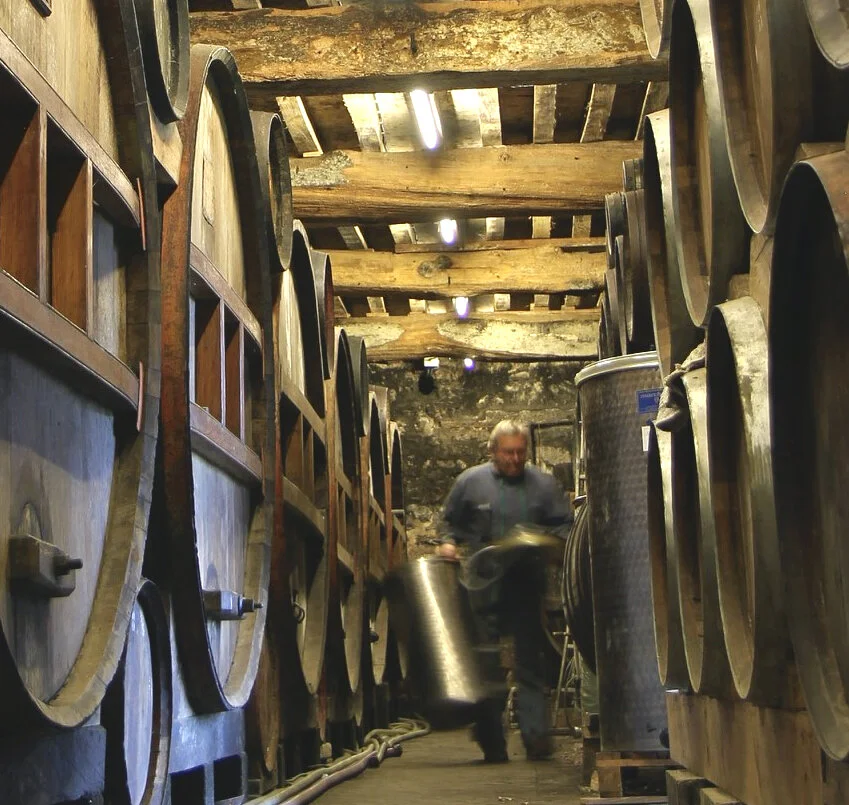
How does one do that? It’s pretty simple. Look at the above photo. You rent a car, drive around from farm to farm, tell the producer you’re interested in purchasing some booze, and then you taste. He or she will walk you into the barrel room or chai (pronounced “shay”), pull some samples out of the giant foudres, and you go from there.

Pulling Calvados samples in the chai at Domaine du Manoir de Montreuil

Pulling Calvados samples in the chai at Domaine du Manoir de Montreuil

As the years went by and our supplemental import program expanded, Charles began offering the same opportunities to other bars and restaurants in California. The cocktail world was exploding and there were a number of adventurous drink menus in search of unadulterated and affordable brandies for their thirty consumers.

But, as you can imagine, with bars and restaurants being closed for the last year, much of those exclusive blends have gone unused and a pressure release valve for that inventory is needed. While retailers have gobbled up the older and more expensive brandies that Charles imports, the cocktail-oriented bottles are without an audience because there’s no one around to explain what’s in them!

But I’m going to remedy that this week. Having been there for a number of these blending sessions firsthand, I’m going to share photos and write-ups on three of Charles’ core producers, as well as purchase them for the store.

Retiring to the drawing room at Château de Briat for some Armagnac tasting

Retiring to the drawing room at Château de Briat for some Armagnac tasting

If you’re champing at the bit to get going, you don’t have to wait for me. I’ve got a number of new Pellehaut expressions ready to go, including the new Selection II meant for making high-quality Sidecars and Brandy Old Fashioneds. I haven’t updated the notes yet, however; and I have some more editing work to do on the text that’s already there.

I’ll also have affordable new Calvados arrivals from Domaine du Manor de Montreuil and a fantastic Cognac selection from Dugognon, one of the last producers in the region to bottle without one drop of added caramel coloring or sweetener.

And I plan to get Charles on here for an interview as well, hopefully an Instagram Live chat next week. Stay tuned.

-David Driscoll

Age

Do you remember being a kid and visiting a new friend for the first time, only to come home completely disoriented because of how different he or she lived than you?

As an example, I distinctly remember going to friend’s house after school in second grade and being shell-shocked by the fact he watched Gilligan’s Island at 4 PM instead of Happy Days. After that he watched Hogan’s Heroes instead of Mork and Mindy. It was too weird for me. I never went back.

In a sense, meeting new people as we get older constitutes a number of the same situations, it’s just that our coping skills have evolved to the point where we don’t freak out over a little adversity. But as the years go by, and we come into contact with younger people, the little differences can become chasms of separation that are too wide to overlook. There are certain ways of living we come to take for granted, and when those comforts are removed from our existence, we have less patience for that new reality.

The first time I went to Bordeaux for the en primeur tasting, I was with my former boss and his friends: all of whom were in their 60s and 70s. They knew the wines from every estate inside and out, and for them the entire week was old hat. For me, I was jumping at the opportunity to experience everything I could; partially because I knew I would never be able to afford to taste the wines on my own. Most of my older colleagues felt differently, however. For them, tasting the wines while knowing the modern prices was depressing, and a constant reminder of how they had been priced out of their favorite pastime.

Because I had never experienced Bordeaux in the 80s or 90s, I didn’t have any of the same expectations. To me, a bottle of Pichon-Baron should cost $150+. For these other guys, however; a bottle of Pichon-Baron will always be stuck in their minds at $20.

Today, the shoe is on the other foot, albeit with whisk(e)y rather than wine. Those of us who cut our teeth on 2007 prices often have a great difficulty paying what 2021 demands. BUT…the younger generation of whiskey drinkers has no issue. For them, a bottle of Pappy may be worth $1000 or more. Many of them have no problem shelling out extra cash if it means securing the chance at a rare experience. I know this because I watch it happen about fifty times every single day now that I’m back in retail.

Some of my older friends and customers have no patience for this. They’re still living in the era where buying a bottle of whiskey meant you were going to drink it, not sit on it for investment purposes. Once you realize a large number of today’s drinkers are looking to capitalize off their purchases, it completely changes the way you look at the industry.

To use a current analogy, those who bought GameStop stock at $50 or less were sitting pretty when they sold those shares for over $400 last week. But, that doesn’t mean the guys who paid $300 and sold for $400 went away empty handed. Even the guys who paid $350 or more still may have turned a profit. The same holds true for rare bottles of American whiskey. You may laugh at what others are willing to pay, but the joke may ultimately be on you.

As an example, you might scoff at paying $150 or more for a bottle of Blanton’s—as a beverage. But what about as an investment opportunity?

Every single day I talk to guys on the phone who have no plan on drinking many of their purchases. Most of them are younger than me. They’re building equity for a resale down the line, or the chance to trade for something better. As one person told me when buying a rare bottle of rye: “I actually don’t like rye whiskey, but I know someone who will trade me something better for it.”

This has happened in a number of pop culture genres over the last decade-plus. Look at the secondary market for Jordans now. 99% of the people buying his basketball shoes have never played hoops, nor do they plan to; it’s purely a fashion statement or an investment.

Whiskey is no different. As I fell asleep last night while watching The Color of Money, I was struck by something Fast Eddie tells Vincent when asked why he no longer plays pool:

“I’m too old. My wheels are shot. It’s a young man’s game. Kids are playing on coke, speed. When I was younger, it was booze. Somehow it was more human.”

-David Driscoll

Instagram Live With Gerald Casale - Next Weds

IMG_3462.jpg

From 2016 to the beginning of 2018, somehow the word got out that if you were a celebrity who wanted to start your own booze label, I was one of the guys to call for advice.

It was humbling, but also weird at times because for many of these brands there was nothing I could do to help. The juice was often poor, and there’s no remedy for bad juice other than to simply get rid of it.

The one guy who absolutely had (and continues to have) great taste, however; was Gerald Casale, the co-frontman for the rock group Devo. Not just with wine and spirits, mind you, but with food. The guy is a fantastic cook. When I moved to LA in 2019, Gerald began inviting us over for dinner and—to this day—I can safely say that his homemade wood-fired pizza is among the best I’ve ever had.

As far as celebrity labels go, I don’t consider Gerald’s 50 by 50 Pinot Noir in the same category as other celebrity brands because there’s nothing hokey about it. Made from fantastic Sonoma Coast fruit, the wine drinks as well as any of its competitors for the price, and often times better. In Gerald’s case, I’m always willing to jump in and help because I wholeheartedly believe in his product (and I drink it at home).

But enough explaining; I’ll let Gerald fill you in on the details this Wednesday at 5 PM when we sit down on the @missionliquor Instagram for a live chat.

See you there!

-David Driscoll