Bourbon For Veterans Day

trio.jpg

You know the famous names of today’s hottest American whiskies: Stagg, Weller, and Handy, for example. 

But do you know who these men were before they joined the whiskey business and became industry icons? They were just like many Americans in the whiskey business today: former soldiers who came home from war and found a career making and selling Bourbon.

George T. Stagg? He was a fearless Civil War officer.

William LaRue Weller? He fought in the Mexican-American war.

Thomas Handy was a Confederate soldier who helped lay the foundation for the Sazerac company, from whom you get your coveted Blanton’s, Pappy, and Elmer T. Lee. 

The late Dave Pickerall of Maker’s Mark and WhistlePig fame served eleven years in the U.S. Army after graduating from West Point. 

My fellow San Francisco Spirits Competition judge and best-selling whiskey writer, Fred Minnick, is a veteran of the Iraq War. He’s actually the person from whom I got all this information, and his forward to the book Bullets and Bourbon lays out this spiritual connection to whiskey. I texted him last night about the subject, and he pointed me to an article where he spoke candidly about his service, saying: “Bourbon allowed me to keep my focus on what’s happening inside my mouth, instead of on a jet that is about to drop a bomb or something.”

There’s an undeniable link between Bourbon and the military, and that relationship forms the foundation of Bullets and Bourbon.

Coincidentally, it was that exact book by John C. Tramazzo that inspired two former Green Berets to start their own whiskey company. Having fought for their country and looking to create the next chapter of their lives, John Koko and Scott Neil decided to follow in the footsteps of their veteran counterparts and start their own Bourbon company. 

But there’s more to the story than just the legacy of American soldiers and whiskey. Quite a lot more.

John and Scott were not only Green Berets, but Scott in particular was part of the original team of ninety soldiers sent into Afghanistan after 9/11 to fight the Taliban and Al Queda; the same mission that was recently turned into a film called 12 Strong with Chris Hemsworth. I caught up with Scott in the store this week as he was visiting from Florida, and he filled me in on more of the details.

“Right after 9/11, small teams of Green Berets were inserted behind the lines in Afghanistan to link up with Mujahideen fighters and create a resistance against the Taliban as well as Al Queda,” he explained; “This was an impossible mission against impossible odds, but yet everybody volunteered and was happy to so. In as little as ninety days, ninety Green Berets had expelled the Taliban, sending Osama Bin Laden into hiding.”
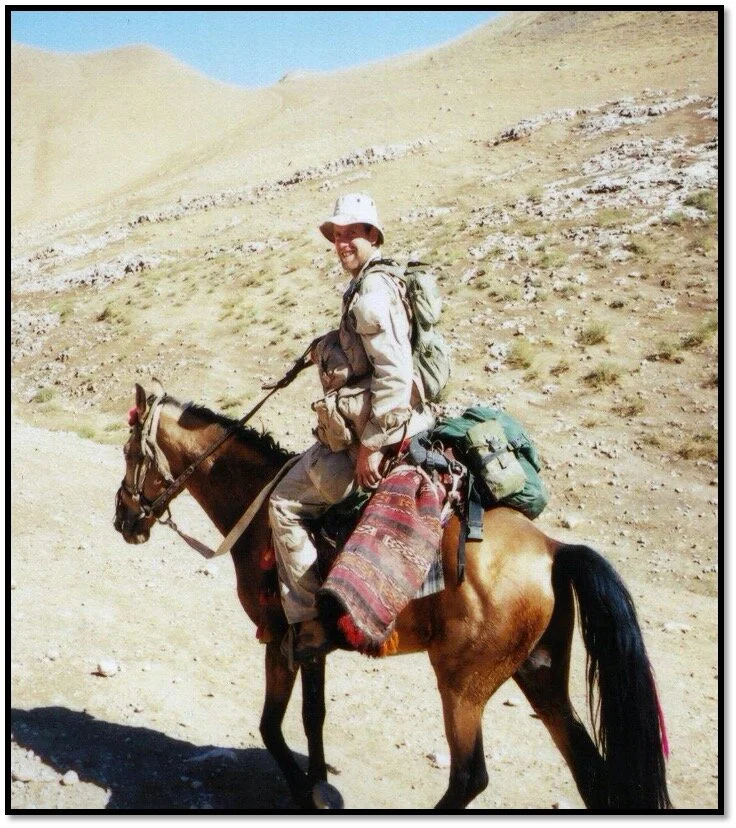
Mark Nutsch in Afghanistan

Mark Nutsch in Afghanistan

Scott and John’s Bourbon label is called Horse Soldiers because of the moniker by which these fighters would come to be known. To help with the brand, they enlisted the help of Mark Nutsch and Bob Pennington, who both fought with Scott in Afghanistan.

“Some of us came into the mountains and linked up with General Dostum and fighters who were on horseback,” he added; “Mark and Bob were the two commanders and they raised a Mujahideen cavalry of 3500 horsemen and 1000 infantry. They took an all-horse cavalry in against tanks, something that hadn’t been done since the first World War.”

Scott explained that because the Taliban had captured all the armor and equipment since the fall of the USSR, they had been able to overpower the smaller towns in the area. As a result, the Mujahideen had reverted to horseback in order to maneuver through the nearby mountains and valleys. As a result, the conflict against the Taliban was a clash of two completely different technological eras.

“We had all served doing various missions, but imagine getting the ultimate mission,” Scott continued; “The country had been attacked. We were not expected to survive. This was an impossible mission against impossible odds, but yet everybody volunteered and was happy to do so.”

After returning from battle, Scott pondered how the rest of his life might play out: “I left the military at the end of 2011, and I worked for a veterans non-profit for a while. I had talked to many successful people who had done well, and they had all invented something or had a family business. I admired their pursuit of the American dream, so I decided I needed to start a business, too.”

Stationed in Afghanistan

Stationed in Afghanistan

It was during that time that Scott and John took a trip to Yellowstone, where they spent time riding horses, climbing the Titons, and fly fishing. They discussed starting a business together, and as the trip was coming to an end, they happened to drive by a small craft distillery offering free tours and tastings. 

“We thought it would be fun to stop and have a few drinks, but we came away with a fascination about how whiskey is made and how it comes to market. So we spent the next three weeks visiting distilleries on the way back to Tampa. We called some of our other friends who we had served with and we decided to go to Scotland.”

The two had contacts with other soldiers who had served in the British Royal Marines at Wolfburn distillery and they spent time working at their facility in Thurso, Scotland. 

“When we got home, we had another military friend with connections to people in Ireland at Teeling and Kilbeggan, so we went and visited them,” Scott added; “We learned different ideas, fundamentals, operations, funding and finance, etc. Not only just the making of the whisky, but the business side as well.”

When the two finally visited Kentucky, they knew that Bourbon was going to be the business. “We were referred to Ryan Lang at Middle West Spirits from another soldier via our network of veterans, but we visited a number of Bourbon distilleries before that. There was a kinship between former soldiers that helped open the door to these businesses in a way that likely wouldn’t have happened if we were a rival or a new distillery.”

Today, Horse Solder Bourbon is made in Columbus, Ohio from two different recipes decided on by the team: a high-rye Bourbon mash bill of 68% corn, 27% rye, and 5% barley, alongside a wheated Bourbon recipe of 70% corn, 20% wheat, and 10% barley. “We liked the higher rye recipes,” Scott explained; “but half of us also loved wheated Bourbons—the whole fantasy of Pappy. Many of us also grew up drinking Maker’s Mark. We couldn’t decide which to choose, so we just decided to do both.” 

While the whiskey is currently made in Ohio, Horse Soldiers is in the middle of building its own Kentucky distillery. “We bought 200 acres in Somerset, Kentucky; about an hour south of Lexington,” Scott outlined; “No one here has any fantasy about the work this is going to take and how much this costs, we’re here because we love this and we want to start a real business.”

Having walked the Bourbon aisle together at Mission, chatting about the endless array of new American whiskies that continues to expand, Scott once again ensured me that he’s ready for the competition. “Just like we had to fight 50,000 Taliban, I feel like we have to 50,000 other brands. And we don’t have billions of dollars at our disposal. All we have is our grit and determination.”

Since tomorrow is Veterans Day, now seems like the right time to tell you a bit more about the Horse Soldier Bourbons:

HorseSoldierBourbon_600x.png

Horse Soldier Straight Bourbon $44.99 - Roughly three and a half years old, bottled at 95 proof, and made from the high-rye recipe, this is a classic profile of charred oak vanilla and herbaceous spice with earthy finish that is bolstered by the richness from the oak.

Horse Soldier Small Batch Bourbon $59.99 - Made from the wheated recipe and bottled at 95 proof, the small batch is marriage of eight to ten barrels, roughly five years of age. In the vein of Weller and Maker’s Mark, it has all the creamy sweetness and baking spice goodness one would expect given the mash bill. 

Horse Soldier Barrel Strength Bourbon $69.99 - The exact proof varies by batch, but this full-throttle wheated Bourbon brings huge waves of vanilla, cinnamon, clove, and pepper as it lights up the palate and sends the taste buds into overdrive.

Besides the opportunity to try a new Bourbon portfolio (one actually made to their specifications, not simply sourced from Indiana), there are other perks to buying a bottle of Horse Soldier Bourbon. “Our bottles were built for charities,” Scott explained, “and part of the proceeds go to help various causes. We’ve raised more than $15,000 for the America’s Response Monument. Each year we focus on one cause, so this year it’s Project Healing Waters, and I just did another event at the distillery for a Veteran’s Day bicycle ride. We’re signing bottles, doing free tours, whatever we can do to give back.”

As to the future, Scott is hoping he can be just as successful as American soldiers of the past like George T. Stagg.

“This is our legacy and our long term investment for our families,” he said before we parted; “Our kids work here, our wives are involved. We grew from three initial friends, to ten, to twenty, to fifty. The majority of us have military backgrounds, but we have some industry people here as well. We just want to make great whiskey.”

-David Driscoll

High On The Mountain

rohtang.jpg

I caught up with Anand Virmani from Nao Spirits recently, the mastermind behind the Jin Jiji and Hapusa gins that are part of a new craft spirit movement in India. I’ve been obsessed with these babies for weeks on end and I was excited to finally teleconference with Anand from Goa, India where the distillery is located. I’ll go into more of the details later, but there’s an amazing story that I want to tell you right now concerning the source of the Himalayan juniper used in the gins and how Anand once drank what could be a Negroni made at the highest elevation ever.

It was after individually distilling more than 100 different Indian botanicals, experimenting with potential flavors, that Anand got the idea to search out juniper grown distinctly within the country, rather than continue to source it from Macedonia as he had done for previous gin projects. He made the trek to Khari Baoli in Delhi, the biggest spice market in South Asia, to see if he could find a vendor sourcing Indian juniper. After two days with no results, he finally came across a tiny, hole-in-the-wall shop where he showed the proprietor a photo of the plant. The man went into his desk drawers and came back with a tiny bag of what looked like juniper and smelled somewhat like juniper, but neither man was sure.

Since he was already planning a trip to the UK the following week, Anand asked if he could take the bag with him and ask some of his distiller friends in London what they thought. After running the juniper through a still at a friend’s distillery, they both confirmed that the resulting spirits both smelled and tasted like real juniper. He had found his source. Returning to the shop in Delhi the following week, he told the owner he’d like to place an order of whatever he called that plant. The man answered: “Hapusa.” 

himalayan.jpg

After launching the Hapusa brand, Anand and his partners decided to take a trip to the source of the juniper in the Himalayas, hoping to document the experience for their website and social media sites. It was a 15+ hour drive from Delhi to the village from where they would make their way into the Rohtang Pass (click here for a cool video I found of the landscape). It turned out to be a much more complicated journey than they had prepared for, as they would need to get permission from the locals to enter the site of the juniper. After driving hours from the village in a tiny car (manned by an aspiring race car driver, according to Anand), they arrived at the mountain entrance, but it turned out the Rohtang Pass into the Himalayas is only open from 9 AM to 6 PM daily, and they didn’t arrive until after 8 PM.

The driver went and spoke to the guard who was willing to look the other way and let them in, but not long after they began their ascent up the narrow, winding mountain roads it became clear why the pass closed so early: at such a high elevation (over 13,000 feet) the cold evening air creates black ice on the roads.

As they began fish-tailing and sliding around each bend, Anand and his friends begged the driver to slow down. “I know what I’m doing, I do this all the time,” he answered confidently each time they pleaded. Finally, they reached the site of the juniper and along with their photographer they got out of the car and did their sightseeing. On the way back, however, it was now much colder and as they approached one of the curves, the driver found that the car breaks were not responding. Anand saw his life flash before his eyes as they approached one of the bends, but just before reaching the edge of the cliff the car hit a huge pot hole and came to a stop. The boys got out to survey the damage and found a huge oil leak, among other problems. They couldn’t get much of a phone signal so high up in the mountains, so they began walking until they could get within range and call for help. 

anandmountain.jpg

The group managed to get a hold of a tow truck, but it was going to be at least three hours before it could reach them, maybe longer considering the pass was closed and no one was supposed to be on the road. Anand had stowed a bottle of Hapusa, a bottle of Campari, and a bottle of sweet vermouth in his bag, so now seemed as good a time as ever to have a drink. They huddled together in the car to keep warm as Anand mixed Negronis for the group and the Mountain Negroni was born! “We thought about calling it the Rohtang Negroni,” Anand said as he finished the story; “But we didn’t think anyone would get the reference. So we stuck with Mountain instead.”

The Mountain Negroni

-David Driscoll

A Long Time Waiting

Todd Leopold looks over a fermenting Bourbon mash

Todd Leopold looks over a fermenting Bourbon mash

It would take me at least ten pages to truly explain just how much of a distillation genius, whiskey savant, and overall booze geek that Todd Leopold is, so let me just say that the real work that we will come to know the Leopold Bros Distillery is only now coming to light.

For the last 10+ years we’ve been drinking their gin, their vodka, their various liqueurs and such, but the true craft of what Todd Leopold can do is finally here. And we’re just getting started. When the Three Chamber Still rye whiskey comes out in January, we’re all going to be on our knees, begging him for more, because that whiskey is just that good, but for now let’s break down the new 5 year old Bottled in Bond Bourbon. 

Screen Shot 2020-11-06 at 2.41.19 PM.png
  • WHY YOU WANT IT: This is real deal, grain-to-glass, pot-distilled farm Bourbon, aged for five years in the Leopold’s government-bonded warehouse, and it beautifully bridges the gap between the grainy, spice-laden flavors of small production whiskies and the richness and sweetness you expect from your favorite Kentucky Bourbon. It’s impeccably balanced and complex from front to back, finishing very soft and very smooth.

  • HOW IT’S MADE: Using 65% local corn, 21% in house-malted barley, and 15% heritage rye, the custom-mash creates a creamy, malty, and very distinct flavor profile, imparted with fruit from the open-top, native yeast, cold fermentation that coaxes out the flavors over 120 hours, more than twice the fermentation time of most other distillers. The Bourbon is also pot-distilled, rather than column distilled, so the whiskey truly tastes more like the mash itself than the new charred oak it was aged in.

  • WHAT/WHO MAKES IT: Todd and Scott Leopold originally built their distillery in Ann Arbor, Michigan, but soon moved to Denver, Colorado for better access to grains. Everything they make is from scratch. 100% of the grains used for their spirits are floor malted by hand, meaning rye, wheat, and barley. With the exception of their grape-based absinthe and maraska cherry liqueur, all of their base spirits are made in house. Todd Leopold is also a professional maltster, selling in-house malted grains to many of the nation’s top craft breweries.

We’ve got plenty in stock right now for the time being. I’ve got my bottle and I keep going back for more as I type this. It’s incredibly lithe for being 100 proof, so I need to be careful. There's so much to like about this: the way it's made, the people who made it, the way it tastes, the complexity of oak, rye, chocolate, malty grains, oatmeal cookie, etc. 

Grab your bottle here:

Leopold Bros 5 Year Old Bottled in Bond Bourbon - $54.95

-David Driscoll

Diffusing Tequila Knowledge

There’s an incredibly-complex, ongoing situation with Tequila that needs a very simple explanation, but unfortunately is quite difficult to summarize.

Last night, however, while stress-eating whatever junk food I could grab at the store before leaving, it hit me: Hot Cheetos.

Hot Cheetos are delicious, right? You can’t stop eating them once you start (at least I couldn’t as the election results kept rolling in). They taste so good, and they’re oh-so satisfying, but you recognize them for what they are: cheap little puffs of starch that are covered with artificial flavoring.

That doesn’t mean you won’t continue eating them, but it does mean that you would never pay $100 for a bag of Hot Cheetos. Or would you?

That’s what I have to ask some Tequila drinkers these days because most of the population has no idea that most of the Tequila it’s drinking is basically distilled starch water with artificial chemicals added to make it taste like Tequila.

It’s called diffuser Tequila. It is the Hot Cheetos of booze. It may taste good, but it’s super cheap to make and it’s full of sugar.

What is a diffuser and why is it such a dastardly machine? I’ll tell you. There are plenty of articles that go into detail about what the diffuser is and how it works, but I'll give you the simple breakdown here: 

  1. Diffusers make Tequila production cheaper and faster! But not better.

  2. As a result of so much production, agave is now short supply! Producers want to get the most potential alcohol from every single piña harvested. Blue agaves take 6-10 years to fully ripen, which is too long for many producers to wait when sales of Tequila are at an all-time high.

  3. Traditionally in Tequila production, the piñas are cooked, crushed, and pressed to extract the sugars, which are eventually fermented in tanks or vats like with winemaking. In both cases, the process requires ripe produce because one needs sugar to start a healthy fermentation (I've always said that Tequila and mezcal are much more like wine than whiskey for that reason).

  4. With the invention of the agave diffuser, the need to cook and crush the agave has been completely eliminated from the process. Instead, an uncooked, under-ripe, sugarless agave is fed into a shredder and the resulting agave chunks are moved onto a conveyor belt into the diffuser. 

  5. The diffuser sprays the agave pieces with hot water that extracts the starch from the pulpy plant and collects it in a tank. Now rather than having to cook the actual agave to create the sugars, the distilleries can instead boil the starch water and add an enzyme to convert that starch into sugar, much like how Bourbon is made (and not at all like wine).

  6. While the diffuser results in a more efficient use of manpower and potential alcohol, it results in a flavorless product. But, much like with processed food, all that "agave" flavor can be re-added later on the back end (like the seasoning on Hot Cheetos). 

  7. Because the resulting diffuser Tequila is still entirely a product of agave, the labels continue to tout their "100% agave" classification and market the liquid as a top quality Tequila, rather than a mixto or blended agave product. It means they can use young agave piñas that have no sugar and no flavor, and still make “Tequila.”

The reason Patrón Tequila was such a big deal when it first launched was because it marketed itself as 100% agave—meaning no added grain alcohol. It’s quite akin to the single malt revolution that began around 2007, when drinkers began passing up blended Scotch because it uses grain whisky to stretch out volume. Savvy sophisticates wanted the good stuff—pure. No baby laxative added to the cocaine. Just the straight product.

From that point on, every premium Tequila began putting “100% agave” right there on the label to distinguish it from cheaper mixtos.

The problem Tequila producers found themselves in nearly two decades later was that the new demand for 100% pure agave Tequila was using up all the agave! But they couldn’t go back to making mixtos because that would destroy the lucrative market they had worked so hard to create. So they invented the diffuser.

Now I know what you’re going to ask next: David, which distilleries are using diffusers?

Let me tell you the hard truth: it’s much easier to ask which distilleries aren’t using diffusers.

And let me add this: while some diffused Tequilas taste very smooth, with lots of richness and no burn, there’s no economical justification for a fancy diffuser Tequila to exist. Yet, they’re out there.

And they’re like $100 bags of Hot Cheetos.

-David Driscoll

(P.S.- If you’d like suggestions as to which producers make a traditional Tequila without diffusers, additives, or other artificial flavorings, check out this blog post here)

Tracking Your Single Barrel

bakers.jpg

Like I mentioned yesterday, I’m still playing catch-up to make up for the 2+ years I was out of the retail loop, but I’m working at a breakneck pace to get back up to speed, tasting as much booze as I can while reaching out to my friends across the industry for more information.

One Bourbon that caught my attention this week was the updated Baker’s 7 Year Old Bourbon from Jim Beam, now with a new package and single barrel status that gives it an updated look and a modern desirability. Not only was the bottle I purchased absolutely delicious, it came with the opportunity to track my single barrel’s individual journey as part of an interactive journey on the Baker’s website. We’ll get to that in a second. First, let’s break it down:

  • WHY: The new and improved Baker’s 7 year old 107 proof Bourbon is hands down one of the best high-proof whiskey options on the market right now, exploding with flavor and finishing with equal blasts of vanilla, oak, and spice.

  • HOW: Jim Beam does not disclose any of its mashbill recipes, but the general belief is that Beam Bourbons use 13-15% rye in addition to 75% corn, the rest being malted barley. When dialed up to 53.5% ABV, the fruit and clove flavors really punch through.

  • WHAT: Part of the Jim Beam Small Batch Series (in addition to Booker’s, Basil Hayden's, and Knob Creek), Baker’s has long been the overlooked sibling in the family. That changed in 2020, however, when positive reviews for the new edition began simmering online with reviewers and consumers alike. Named after former distiller Baker Beam, the label was first released in 1992.

I’m nosing my particular single barrel expression of Baker’s right now and, again, I’m getting lost in Big Red cinnamon gum aromas, mixed with Blackjack cloves. The vanilla comes through as you pull your nose away, then you sip and BOOM: your palate lights up with herbaceous rye notes, citrus, and more baking spices.

The Baker’s 7 year single barrel is not the rich, supple, mouth-coating Bourbon you’ve been looking for as a Blanton’s alternative. It is, however, the big, spicy, sweetly-scented powerhouse of Bourbon you need for a rocks pour, or a more potent Manhattan. Even as a straight sipper, if you like bold, assertive Bourbon concentration, this is a great grab.

Screen Shot 2020-11-04 at 6.32.44 PM.png

Like I mentioned above, if you input the serial number on the neck of your Baker’s single barrel bottle, you can virtually roll your barrel through the rickhouse and track the data on your particular whiskey. My barrel was aged towards the top of the pile, meaning it likely went up in proof over time due to evaporation and the 102 degree heat it withstood.

But that doesn’t necessarily translate into why my bottle of Baker’s tastes so darn good, it’s just a fun little diversion to help me better understand how the transformation occurred. Personally, having spent my formative years obsessing over Bourbons from Buffalo Trace, Four Roses, and Wild Turkey, I’ve been very impressed by a number of Beam whiskies this year, from this single barrel of Baker’s, to some of the Knob Creek editions out there, to the last batch of Booker’s I tried. Something good is happening in Clermont, KY. Whatever it is, I’m on board.

-David Driscoll

Playing Catch Up

IMG_7927.jpg

When you work in distribution and importation, you get to try a lot of booze. Unfortunately, 99.9% of it is the booze in your portfolio and little else. It’s a stark contrast to retail where you get to try everything, from every producer, in every portfolio sold in the state you do business in.

When I first worked in retail between 2007 - 2018, I was tasting upwards of sixty new products a day. But for the last two and half years I’ve been siloed, without access to the broader market. Knowing that I was heading back to retail in the interim, I began reaching out last month to friends and suppliers in California to start playing catch up.

While blowing through countless bottles of single malt, there were two whiskies (new to me) that absolutely knocked my socks off. One more than the other, but both are simply divine. Let’s start with the GlenAllachie 12 year:

  • WHY: GlenAllachie 12 is the richest, fruitiest, most mouth-coating sherry-aged 12 year old single malt on the market right now. It’s like liquid milk chocolate on the palate and the price is absolutely right.

  • HOW: Using a combination of PX Sherry, Oloroso Sherry, and Virgin Oak casks, Billy Walker (of GlenDronach and Benriach fame) has found the literal sweet spot with this fantastic release. It meanders from cakebread to ginger snaps, but it’s the unmistakable note of chocolate on the finish that seals the deal.

  • WHAT: GlenAllachie Distillery, formerly part of the Chivas Blended empire, was purchased in 2017 by an independent group who immediately brought in veteran Billy Walker to put his mark on the malts. The entire line-up was revamped in 2018 and an exciting array of new releases has been coming since. The 12 year is bottled at 46% ABV.

Simply put: if you like Macallan 12, then you’re really going to like GlenAllachie 12.

If you like GlenDronach 12, then you’re really going to like GlenAllachie 12.

I’ve been drinking it non-stop since I first got the bottle and, no matter what mood I’m in, this whisky delivers the goods every single time. My wife bought a bag of Italian chocolate cookies from Eataly last week and I about died after that pairing. I couldn’t stop eating more cookies and drinking more GlenAllachie because it was so damn delicious. The sherry flavors are never bitter, or tannic, or over the top in any way. Ultimately, it’s the balance of this whisky that’s so utterly impressive. There are no rough edges and nothing is out of place.

Case in point: you need this in your life. Get a bottle now. Maybe even get two. Your mouth will thank you.

IMG_7928.jpg

Now let’s talk about the new Kilchoman “Am Bùrach,” which means “a mess” in Gaelic. We’ll get to the story in a minute, but let me tell you first: this whisky is far from a mess. It’s my new go-to Islay malt and it’s the one whisky in my collection that continues to wow my socially-distanced guests when I pour it for them during our backyard tasting sessions. Here’s the scoop:

  • WHY: Because the combination of sweet and peat, when done well, is one of the most enticing and intoxicating flavors in the world of whisky, and the Kilchoman “Am Bùrach” is a masterful marriage of soft, supple fruit flavors and potent Islay peat smoke.

  • HOW: A batch of Kilchoman “Machir Bay,” matured in Bourbon and Sherry, was accidentally vatted together with the Port-matured Kilchoman, so it took additional maturation of six years in Bourbon barrels and a six month finishing in ruby Port casks to round out the mistake.

    WHAT: The resulting “mess” is roughly 10,500 bottles of 9 year old Kilchoman, bottled at 46% ABV, matured three different types of casks, multiple times!

There was a time when I would tell customers to splurge on a bottle of Lagavulin 16 or Talisker 18 to get a real idea of the pleasure that peated island whisky could deliver. Today, however, given the price hikes, the tariffs, and the general decline in the price-to-flavor ratio, I’m switching my allegiance to the Am Bùrach. It’s not cheap at $129.95, but for the extra dough you’re getting a true crowd pleaser that will have you going back for seconds and thirds.

Kilchoman’s small scale of production and even smaller heart cuts (the portion of the whisky that is kept during distillation) have proven time and time again to work. When I say “work,” I mean that Kilchoman is able to create whiskies of impeccable quality at an age much younger than its Islay competitors. That process costs more for the consumer, but as I’ve personally experienced many times, Kilchoman’s whiskies are often more potent, more concentrated, and more delicious than many of the genre’s older expressions.

If you’re a fan of sweet peat, this is a home run. If you’re a fan of Islay whiskies, this is the best tasting new Islay whisky I’ve had this year. The nose is a hedonistic splendor of butterscotch melting over a peat fire. The sweetness from the Port on the palate rounds out the entry, softening the journey for the rest of the elements: salt, smoke, fresh peat, caramel, and cherries.

YUM……

-David Driscoll

The Indiana Jones of Mezcal Has Come to California

IMG_6539.jpg

If you haven’t figured it out already, agave products are booming at retail. Whether it’s because of pop culture trends, health reasons (some people think agave spirits process through the body more cleanly), a growing interest in Mexican food and culture, or all of the above, there’s no getting around the fact that more retailers are pulling the trigger on Tequila and mezcal these days. The sales numbers are truly staggering.

As any spirits category begins to grow and a wider selection becomes available, customers begin asking questions like: “What’s the best?” or “What should I be looking for when I’m in the mood for something special?”

In the case of mezcal, higher prices don’t necessarily mean better flavor. But in many instances, when a bottle of mezcal costs $100 or more, it’s usually because the spirit itself is distilled from a type of wild agave. Whereas Tequila is always made from cultivated blue agave, and the large majority of standard-labeled mezcals are made from cultivated Espadín, wild mezcal distillates are made from rare types of agave that must be foraged for and searched out. Almost like truffles.

Then they have to be transported from the various locations where they’ve been discovered back to the palenque, often down mountain slopes and through treacherous terrain. And agave piñas are HEAVY! Hence, the work is difficult. That’s what you’re paying for.

But do they taste better? Sometimes. Sometimes not. It all depends on the distiller, the harvest of agave, and the process. Even then, there’s often huge variation from batch to batch, so you really have to do your research and taste as much as possible in order to develop your taste preferences.

However, if you don’t have time for all that fun and you’re looking for something truly special—an expression of agave that explodes with flavor on the palate and keeps you coming back again and again—then I have the bottle for you.

We just received a few cases of the new Pal’Alma Aguardiente de Agave “Salmiana” uncertified mezcal last week. It’s not labeled as mezcal because it was doesn’t adhere to the official DO requirements (think of Champagne made outside of the region of Champagne or from different grapes).

So why the fuss?

Pal’Alma is the export brand for Almamezcalera, the bottling label from Mexico City’s notorious “Indiana Jones of Agave” Erick Rodriguez. Equal parts historian and adventurer, Erick travels to remote production sites all over Mexico and is deeply committed to local traditions that are rooted in rustic ingenuity. His collaborators are all bonafide local legends in their own right, and—to make things even cooler—Erick only works with a single mezcalero in each state! Several of them, such as Nuevo León and Sonora, are not currently acknowledged under the “Mezcal” Denomination of Origin, so Erick bottles tiny batches of truly thrilling, uncertified agave distillates. Let’s take the current release as an example: the Salmiana from San Luis Potosi, a state in central Mexico, just northeast of Jalisco.

IMG_6540.jpg

The first batch of Pal’Alma’s uncertified mezcal (or Aguardiente de Agave) is distilled from Salmiana agave, which grows around 6,000 feet above sea level. Known for its thick dark leaves, which curve and twist as they mature, it can grow to more than seven feet wide and tall, taking anywhere from 12 to 25 years to reach maturity. Erick works with Maestro Patricio Hernandez, who cooks the piñas in a stone oven, then mills the cooked agave using a traditional tahona.

But here’s the kicker.

During fermentation, roughly 30% fresh pulque is added to the crushed agave in a pine vat, almost like adding sour mash into your Bourbon mash bill. After eight days, the resulting fermented ‘tepache’ is distilled twice in a copper pot, using a condenser to further rectify the spirit. It bursts with bell peppers and fresh leather on the nose, bolstered on the palate by the creamy lactic notes for which Salmiana is famous, and a racy edge the that reminds us it was distilled using sharp, light pulque. On the finish you’ve got cracked peppercorns and a hint of pine with loads of citrus and spice. It is spectacular stuff, by far the most impressive agave spirit in my home bar.

And get this: Erick’s selections were previously presented only at his small, appointment-only tasting room in DF, and as exclusive batches with iconic venues like Omar Hernandez Gallery in Oaxaca and Pujol in Mexico City. They are coveted by mezcal aficionados around the world, especially because you had to meet with him directly to buy a bottle. You literally had to make an appointment and fly to Mexico CIty in order to get one!

We’re very lucky to now have access to Pal’Alma here in California and, for you lucky customers, we’ve got them on the shelf at Mission. If Erick is the Indiana Jones of mezcal, then this Salmiana edition is very much the holy grail of agave spirits.

-David Driscoll

Drinking to Drink: A Mission Booze Blog Primer

winecellar.jpg

If you woke up tomorrow and all of your followers were gone, could you go back to being you?

That’s what a recent Netflix documentary about social media asked its viewers. It’s a line that’s been stuck in my head since I first watched it because it’s exactly what I’ve been trying to do for the last two years: go back to being a guy who just likes to drink and have a good time. In the Spring of 2018, after more than a decade of working wine and spirits retail, writing daily a blog about alcohol, researching new brands, and making the study of booze my end-all be-all, I decided to quit. In the wake of one difficult decision, all of my social media followers were effectively gone overnight. Yet, as the question above alludes to, it’s not always easy to transition from having thousands of people asking you for your advice one day, to having absolutely no one care about your opinion the next.

For those of us who obsess over booze, why it tastes the way it does and where we can find our next exciting fix, the curation of alcohol impacts our daily life. Everything in my world revolved around what I was going to drink that day, and the diversity of what was in my liquor cabinet was like a global passport. There was something new and interesting on the menu every night because my generation had completely eschewed brand loyalty in the name of drinking better stuff, searching out the most exciting new drinks from the world at large. Yet, in a twist of irony, our endeavors made us even more label conscious than our predecessors—without any of the loyalty. 

What does that mean exactly? It means that rather than stick to our favorite brands like our parents did, we became devotees of the data—and there’s a lot of data to mine in the booze world. Instead of asking the bartender for a pour of our favorite label, we asked if there were any whiskies on the menu above 52% ABV, ten years or older? We thought the specs would help us weed out the good stuff from the mediocre because understanding the data points of alcohol helps create a simplified formula for quality assessment. And it did. At first. 

As time went by, however, I had more customers asking me about the numbers on the label than the actual liquid in the bottle, as if they could crunch those numbers into a qualitative calculation from just the specs alone. Pretty soon, finding a new whiskey seemed to be more about winning than drinking. Winning a debate. Winning a contest. Winning the internet. With data.

To me, however, turning alcohol into hard statistics always made me feel like I was losing. Losing my passion. Losing my career. Losing myself. 

For the last two and a half years, I’ve been working behind the scenes with bartenders, restaurants, and various retailers, trying to figure out if anyone still cares about flavor. It used to be that we tasted something, decided whether we liked it, then worked backward to figure out why. Our exploration started with enjoyment and ended with intellectual fulfillment. Today, however, many of us have flipped that approach, impacting our ability to simply enjoy our beverages. I’ve met and known many a drinker who, before even tasting a spirit, has already made up his or her mind as to whether it’s worth drinking.

What’s the ABV? 43%? Too low.

What’s the age? 7 years? Too young.

What’s the percentage of rye in the mash bill? 13%? Too bland.

How many bottles did they make? 10,000? Too many.

We tell ourselves we’re simply investigating a potential new purchase, using data to drive our decision making, but instead I feel we’re boxing ourselves into a prejudice. In deciding whether a product has merit before we’ve yet raised it our lips, we’re making judgement calls about quality based on numbers rather than our own taste buds. It’s no different than buying a wine based solely on a 90+ point score.

That’s not to say that one can’t determine a number of characteristics about wine or whiskey based on hard data, like the level of alcohol or the age and vintage. It’s true that these numbers give us an early idea towards the likelihood of our eventual appreciation; hence, their importance to the modern consumer. But I think flavor itself is getting lost in all the math. Higher numbers, like age statements and ABVs, equate to higher prices, regardless of whether they actually taste better. Because consumers have now been conditioned to seek out these specifics, booze companies know they can charge more for something based on stats rather than flavor. That’s why there are so many mediocre whiskies out there from a single barrel at cask strength that would have tasted much better as part of a larger blend.

Flavor is becoming less relevant to wine and spirits marketing because it’s hard to quantify (that’s why the 100 point Parker system exists). Personal taste is subjective, so it’s increasingly tossed aside for numbers that are easier to sell. Flavor also can’t be captured in a photo and plastered all over Instagram as a bragging point for the validation of others; we need something more concrete that can generate likes and retweets. As the aforementioned documentary points out: the dark path to despair on social media begins when you start to believe your happiness depends on the approval of strangers. I would argue that the same dangers have become prevalent in the world of wine and spirits, where drinkers are increasingly anxious about how their beverage rates online.

I think a large number of consumers are ready for a reboot, or a back-to-basics approach that puts drinking at the center and flavor at the forefront. That’s why returning to retail with Mission Wine & Spirits and working with real consumers once again has me so excited. Our team is driven by a genuine passion for great tasting products and we love sharing that enthusiasm with our customers. We’ll have all the data too, but it will always point back to flavor and why exactly you might want to try something new and delicious. Mission carries just about everything, which means I have a lot of catching up to do (and a lot of product descriptions to start writing), but there’s nowhere else I’d rather be than here, with this company, doing what we do best. 

To answer the initial question posed about social media: yes, you can go back to being you once you lose all your followers. You can also go back to a time when alcohol was something you looked forward to, rather than something you agonized about after spending two hours on Reddit arguing with a bunch of geeks. You can drink alcohol just to drink it, without the perfect food pairing or a three course meal. You can add ice if you want. You can drink from a plastic cup. You can do whatever you want because ultimately this is life, not a competition. Data does not equate to happiness. If you’re not enjoying yourself, you don’t win. 

Alcohol should taste good and make you happy—pure and simple. To paraphrase Marie Kondo, the act of drinking should spark joy. If it doesn’t, you need to get rid of the clutter. That’s what this blog is here to help you do.

If reading this initial entry has you thinking to yourself: who in the hell cares this much about alcohol?! That’s fantastic. Don’t change. We’ll keep you up to speed with some fun stuff here at our new site. But if you’re looking to get the most out of each bottle you purchase, I’m here to help make drinking a bit more fun. It starts right now.

Welcome to the new booze blog.

-David Driscoll